The Shop Window Before the Shopping Mall
The shop window before the shopping mall was shaped by its street setting. Learn to read how glass, display choices and passing viewers form a public scene.
The most common mistake when reading a shop window before the shopping mall is to treat it as a small advert. That overlooks the practical work of the glass: it separated goods from the street while letting passers-by see them. Start with the frame, the objects and the pavement-facing view, and you can describe how this particular window worked without assuming a single history for all shops.
Read the window as a boundary between shop and street
A shop window is both a barrier and an opening for the eye. Glass can shield merchandise from weather and handling while keeping it visible from outside. The balance depends on the shop: a shallow display with a backing panel offers a selected view, while a clear pane into a deeper interior reveals more of the working space.
Begin with what is visible. Is the pane broad or divided by a heavy frame? Does the sill hold goods, or does a backing board stop the view? These details describe the window in front of you; they do not, by themselves, establish when or why its design became common.
Then look at the position of the merchandise. A row at eye level makes a different visual offer from a heap on a counter or objects arranged on raised platforms. The display controls access: a passer-by can look closely, while the glass keeps hands on the street side.
See how selection turns stock into a display
Objects can suggest a relationship through their placement. A hat beside gloves may read as a possible outfit; repeated colours or a shared platform can make separate goods seem part of one group. These are observations about visual arrangement, not evidence of a universal timeline in which every shop moved from piled stock to composed scenes.
Ask what is centred, what is grouped and what has been left out. A prominent object may draw the eye; a cluster may make the selection feel abundant. A display reads as deliberately composed when its spacing, hierarchy or backdrop shapes how the goods are seen.
Materials contribute to that reading. A fabric backing can separate goods from the interior; a mirror can add reflected objects and street views; a printed sign can direct attention towards a name, price or offer. These choices are evidence of how a specific display is arranged, not proof of a broader historical change.
Include the passer-by in the composition
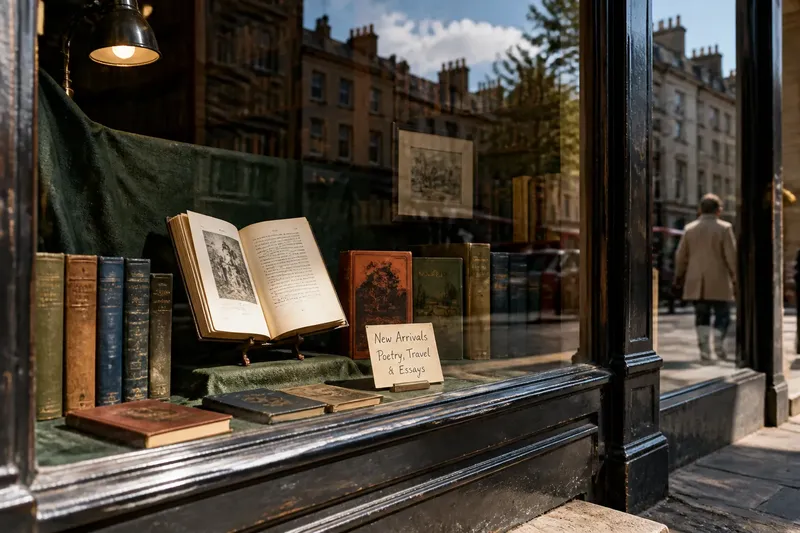
A window is seen from changing distances and angles. A large shape may register as someone approaches, while a small label becomes legible only at close range. Glass can also layer reflections of coats, buildings, clouds or traffic over the merchandise. Depending on the viewer’s position, those reflections may obscure details or connect the display to the street around it.
The surrounding pavement matters too. A narrow route may leave little room to stop; a recessed entrance may offer space to pause. A low sill and a raised platform present different views to people of different heights. Describe what the setting permits before deciding what the display invites.
Distinguish a staged scene from a working shop
A backdrop, platform or lamp can give merchandise a theatrical arrangement, but the window still belongs to a shop with goods for sale. Unlike a poster that can be placed away from the business it advertises, a shop window sits beside a particular entrance. Its visual invitation points towards that threshold, even as the glass keeps the viewer outside.
Imagine a bookseller’s deep, dim window with unrelated titles pressed against the pane. The owner moves several books around one open volume, adds a plain cloth backing and places a handwritten sign beside it. From across the pavement, the open book becomes the first thing to notice; closer up, the covers and pages remain visible. The trade-off is that the sign and central volume organise attention, while some titles are no longer equally prominent.
Compare a street window with a mall display
A street-facing window shares its view with weather, neighbouring façades and moving traffic. Its reflections and sightlines change with the pavement and the viewer’s approach. A mall display faces an enclosed retail route instead, where the surrounding light and circulation differ from those of an open street.
Neither setting is automatically more inventive. The useful comparison is specific: does glare make the street window hard to read, or do nearby signs compete with it? In a mall, does the display stand apart from adjacent shopfronts, or does the interior route shape where people pause? These questions describe viewing conditions without making unsupported claims about when retail displays changed.
Which details help you read a shop window?
Why are goods placed behind glass?
Glass can protect merchandise while keeping it visible from the street. In a particular window, look for how the pane and frame shape that balance between viewing and access.
When does a display read as a composed scene?
Look for choices such as grouping, hierarchy, a backdrop or directed lighting. If those choices guide attention, the arrangement reads as composed rather than simply fitted into available space.
How do reflections change the view?
Reflections place parts of the street over the display, and their strength changes with angle and movement. Shift position to see whether the goods become clearer or more obscured.
How does a mall window differ from a street window?
A mall window faces an enclosed retail route, while a street window faces an open pavement and its changing surroundings. Compare the actual light, reflections and viewing path rather than assuming either setting produces one kind of display.
Use a concrete reading order for the display
These checks keep an interpretation close to visible evidence. For each observation, follow the decision it supports; if the feature is absent, use the alternative rather than filling the gap with a guess.
- Check where the display first comes into view; if it is visible from along the pavement, note that approach, but if it appears only near the entrance, begin your reading there.
- Check whether the pane is divided by a frame; if it is, describe how the divisions separate the view, but if it is not, consider how the open pane connects the display to the interior.
- Check whether a backing panel blocks the deeper shop; if it does, read the window as a selected view, but if it does not, include the visible interior in your description.
- Check which object attracts attention first; if one stands out, identify its position and supporting choices, but if none does, describe the display as a group without inventing a focal point.
- Check whether signs or lighting direct attention; if they do, say what they draw the eye towards, but if they do not, assess the grouping and materials instead.
- Check how reflections change when you move; if they cover key goods, note the obstruction, but if they reveal the street alongside the merchandise, describe that overlap.
- Check whether the nearby pavement offers room to pause; if it does, consider the close view, but if it does not, focus on what can be read while passing.
It is not worth assigning a secret meaning to every ribbon, prop or colour. Begin with observable choices: what is protected, what is prominent, where someone can stand and how the view changes as they move.
A shop window before the shopping mall can be read as a working boundary and a public composition, but its details belong to its particular setting. The phrase shop window before the shopping mall is useful as a point of comparison, not a licence to turn varied displays into one tidy historical sequence.